Beyond the Qualification: Building Self-Aware, Adaptable Leaders
Leadership development is most effective when people don’t just learn what good leadership looks like; they develop a deeper understanding of how they personally lead, communicate and respond to others.
That’s an important part of how Future Institute of Australia approaches the BSB40520 Certificate IV in Leadership and Management.
Rather than delivering leadership training as a series of generic learning blocks, we use online diagnostic / self-awareness tools throughout the program to help participants understand themselves before exploring the relevant leadership concepts and practical skills associated with each area.
The result is a more personalised learning experience that encourages participants to reflect, challenge their assumptions and consider how their natural preferences and behaviours affect the people they lead.
Starting with self-awareness
Every leader brings their own experiences, personality, habits and preferred ways of working into the workplace.
Those preferences can be strengths, but when we’re unaware of them, they can also influence how we communicate, make decisions, respond under pressure and manage different personalities.
That’s why our approach incorporates online self-assessment and diagnostic tools before relevant learning blocks, giving participants insights into areas such as:
- Default leadership styles – helping participants recognise how they naturally lead and when they may need to adapt their leadership style to suit different people, situations and challenges.
- Emotional intelligence – exploring self-awareness, self-management, social awareness and relationship management; by identifying their strengths and areas of improvement.
- Leading Safety behaviours – helping participants reflect on the behaviours they demonstrate as leaders and how these can influence safety culture, conversations, decision-making and the willingness of others to speak up.
- Leading with Accountability – exploring how participants approach ownership, expectations, follow-through and accountability, and how their leadership behaviours can either strengthen or undermine a culture of personal and team accountability.
- Responses to conflict – using a self-assessment aligned with the Thomas–Kilmann conflict model to help participants to understand their default response to conflict.
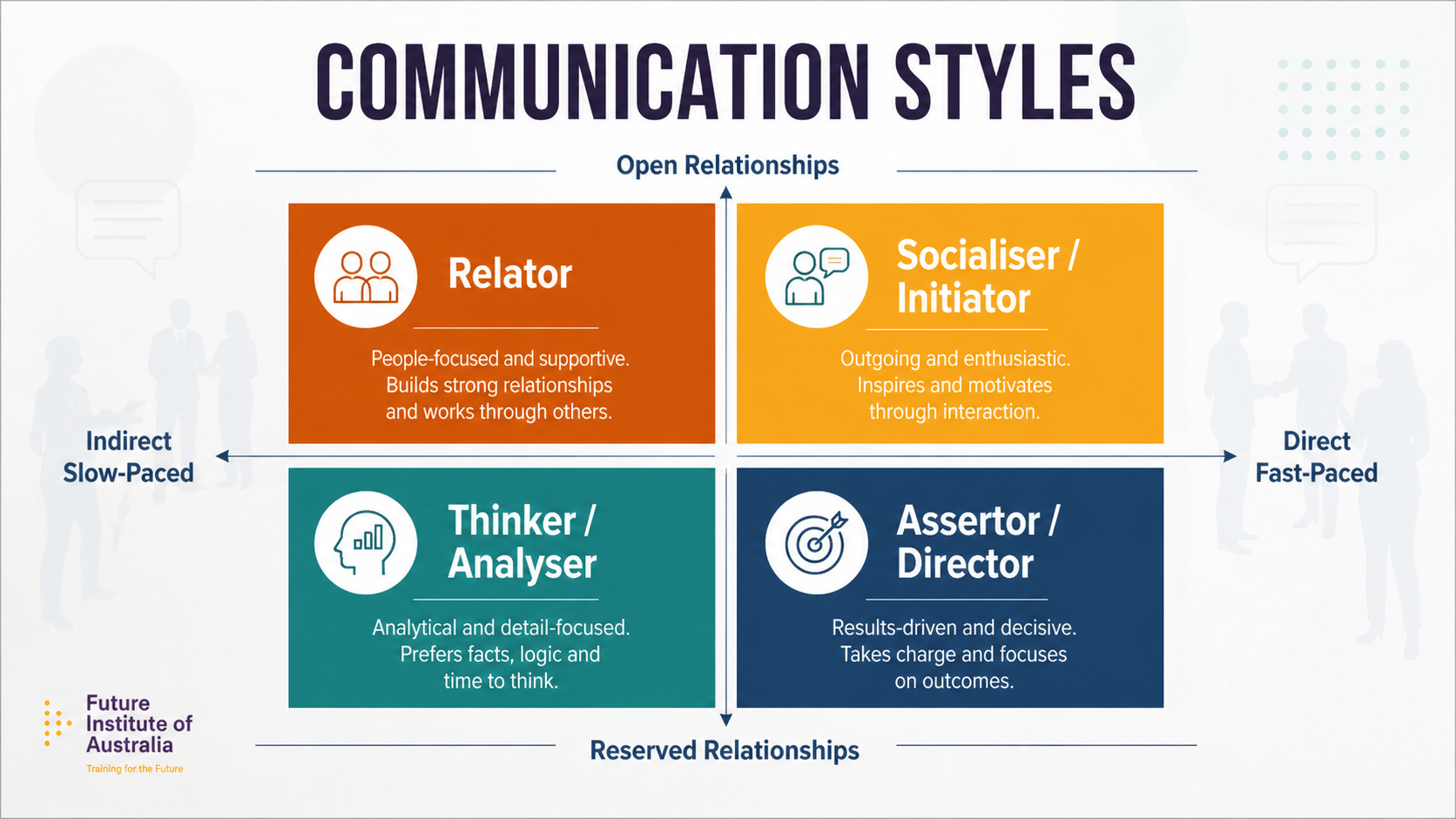
- Communication styles – identifying preferred ways of communicating and helping participants recognise that the way they naturally communicate may not always be the way another person needs to receive information.
- Learning styles and preferences – helping participants reflect on how they prefer to take in, process and apply information, while recognising that the people they lead may have different learning preferences.
Importantly, these tools aren’t about putting people into boxes or labelling someone as a particular “type” of leader.
They are designed to create awareness, not labels.
They provide participants with a framework for reflection, create meaningful conversations in the training room and give them a personal reference point for the learning that follows.
Turning insight into practical leadership capability
The real value comes from what happens after participants receive those insights.
For example, discovering a preferred communication style is interesting. Understanding how that style might contribute to a difficult conversation with a team member — and then learning how to adapt it — is where development starts to become meaningful.
Similarly, understanding your default leadership style is only the beginning. Participants can then explore questions such as:
- Is this the leadership approach my team needs from me right now?
- How does my behaviour change when I’m under pressure?
- Do I communicate in the way I prefer to receive information, rather than the way the other person needs to receive it?
- What impact does my behaviour have on psychological and physical safety within my team?
- How can I adapt my approach without losing authenticity?
These conversations help move leadership development away from theory and into the reality of leading people.
Leadership isn’t one-size-fits-all
One of the most important lessons in leadership development is that there is rarely one leadership style, communication approach or management technique that will work in every situation.
Effective leaders need the ability to adapt.
A leader may need to coach one team member, provide greater direction to another, navigate conflict between colleagues, communicate organisational change, address poor performance or bring a team together around a shared goal — sometimes all in the same week.
Self-awareness gives leaders a stronger foundation from which to make those choices consciously rather than simply relying on their default behaviours.
Customising the BSB40520 Certificate IV in Leadership and Management experience
The diagnostic tools form part of our broader approach to customising the BSB40520 Certificate IV in Leadership and Management.
We work with organisations to understand their workplace, people, operational environment and leadership challenges, and then make the learning as relevant as possible through company-specific scenarios, workplace examples, organisational policies and procedures, and flexible delivery.
This means participants aren’t simply working towards a nationally recognised qualification.
They’re applying their learning to the conversations, relationships and leadership challenges they encounter in their workplace every day.