Why Use Surveys Before and After a Program?
The pre-program survey establishes a starting point before formal learning begins. It helps participants identify their current strengths, development priorities and areas where their perception may differ from their manager’s feedback.
These insights can encourage greater self-awareness and give participants a clearer focus as they move through the program.
The post-program survey is completed at the conclusion of the learning journey. It revisits the same leadership and management behaviours, allowing participants and their managers to reflect on progress, recognise improvements and identify areas requiring continued development.
Used together, the surveys provide a clearer picture of behavioural change over time than a single end-of-program evaluation.
Aligned with Your Leadership Program
Each survey is developed around the content and intended outcomes of the leadership program. Rather than measuring generic leadership characteristics, the questions focus on the behaviours participants are expected to strengthen and apply in their roles.
Depending on the program, this may include areas such as:
- Communication and active listening
- Emotional intelligence and self-awareness
- Adapting leadership approaches
- Providing feedback and coaching
- Managing conflict and difficult conversations
- Setting expectations and creating accountability
- Supporting performance and development
- Leading safe and respectful teams
This alignment ensures the survey results are relevant to the participant’s learning experience and the organisation’s leadership priorities.
What Does Each Survey Include?
Participant self-assessment
Each participant completes an online self-assessment aligned with the leadership and management behaviours explored throughout the program. This encourages reflection on how consistently they demonstrate these behaviours in their everyday role.
Line manager feedback
The participant’s line manager completes a corresponding survey, providing structured feedback on the behaviours they have observed. This contributes a broader perspective on the participant’s strengths, development needs and workplace application.
Reports Provided
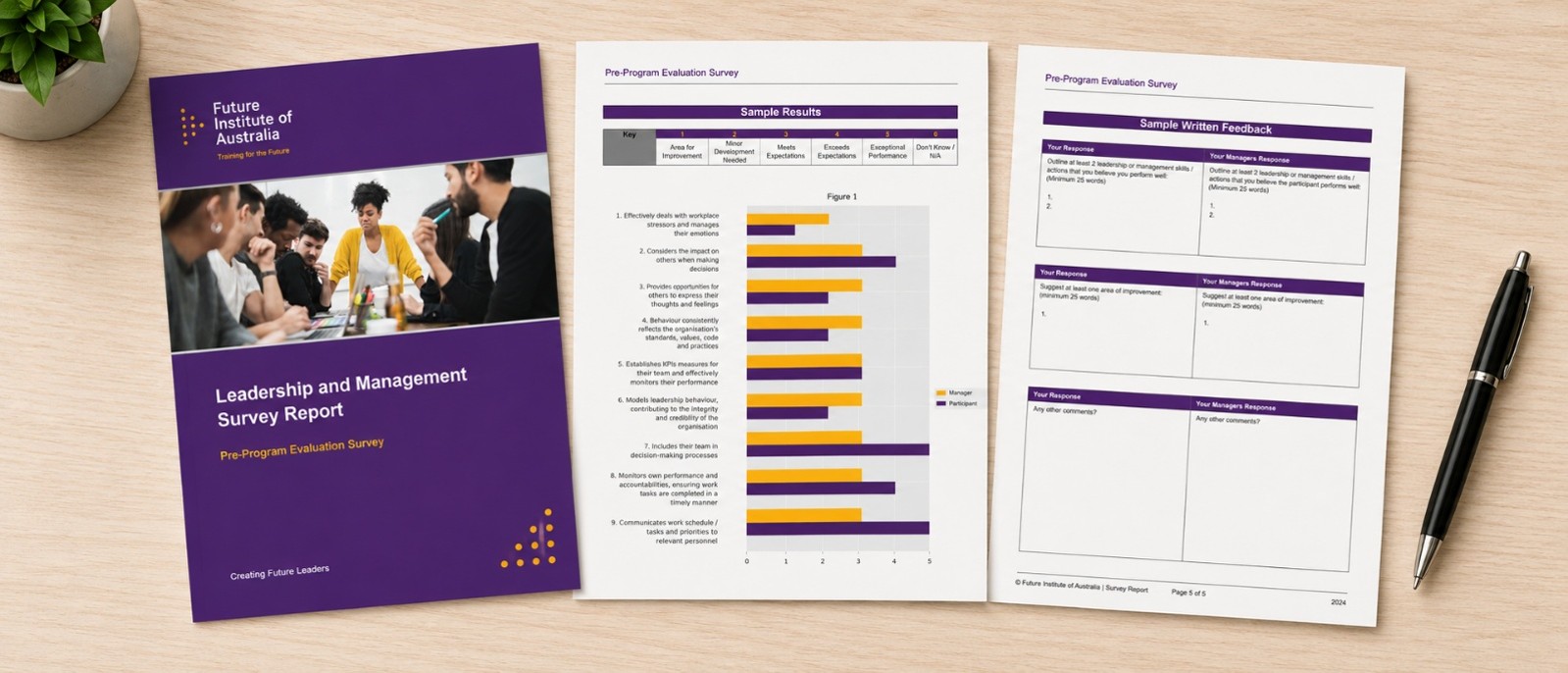
Pre-program individual report
The pre-program report is provided at the commencement of the program. It compares the participant’s self-assessment with their line manager’s feedback, helping to identify existing strengths and development priorities.
The report can be used to guide personal goal setting, coaching conversations and areas of focus throughout the program.
Post-program individual report
The post-program report is provided at the conclusion of the program. It shows how responses have changed and highlights areas of progress, improvement and ongoing development.
This gives the participant and their manager a practical foundation for discussing how learning can continue to be reinforced in the workplace.
Combined organisational report
An anonymous group-level report summarises the pre- and post-program results across the participant cohort. It identifies broader patterns and changes, helping the organisation understand where leadership capability has developed and where further support may be beneficial.
While survey results should be considered alongside other indicators, the combined report provides valuable evidence to support an understanding of overall program impact.
Supporting Learning Beyond the Workshop
The real value of a 180° survey is not simply in collecting feedback. Its value comes from using the results to support meaningful conversations and ongoing development.
Pre-program insights can help shape participant goals and establish a clear focus for learning. Post-program results can then support conversations between participants and their managers about progress, workplace application and the next steps in their development.
By involving line managers in the process, organisations also strengthen the connection between formal learning and day-to-day leadership practice. Managers are better positioned to recognise improvements, reinforce new behaviours and continue supporting participants after the program has concluded.