
How Leaders Guides Strengthen the Impact of Customised Development Programs
At Future Institute of Australia, we believe impactful leadership development begins in the workshop and is sustained through ongoing reinforcement in the workplace. While participants gain valuable knowledge and skills during facilitated learning, long-term behavioural change is achieved when those learnings are consistently supported back on the job.
One of the most effective ways to embed learning is by ensuring participants’ line managers understand the language, concepts, and leadership frameworks introduced throughout the program. When line managers are actively engaged in the development journey, they can reinforce key messages, continue meaningful coaching conversations, encourage practical application, and provide ongoing support as participants implement new skills in their everyday roles.
Without this shared understanding, valuable learning can quickly lose momentum once participants return to the workplace.
To maximise learning transfer and create lasting organisational impact, Future Institute includes active involvement from participants’ line managers as a key component of our customised leadership development programs. Each line manager receives a comprehensive Leaders Guide, specifically designed to align with the program content and provide practical tools, discussion prompts, workplace activities, and coaching guidance. This enables line managers to reinforce workshop learning, support behavioural change, and help participants successfully translate new knowledge into improved leadership practice.
Why Leaders Matter in Learning Transfer
Research consistently shows that one of the biggest influences on learning transfer is the participant’s manager support. Employees are significantly more likely to apply new knowledge and behaviours when their workplace leaders actively reinforce the learning journey.
Without reinforcement, even the most engaging workshop can become a standalone event. With leadership involvement, however, learning becomes integrated into workplace culture and performance conversations.
Our Leaders Guides are designed to make this process practical, accessible, and easy for managers to implement.
What Is Included in the Leaders Guide?
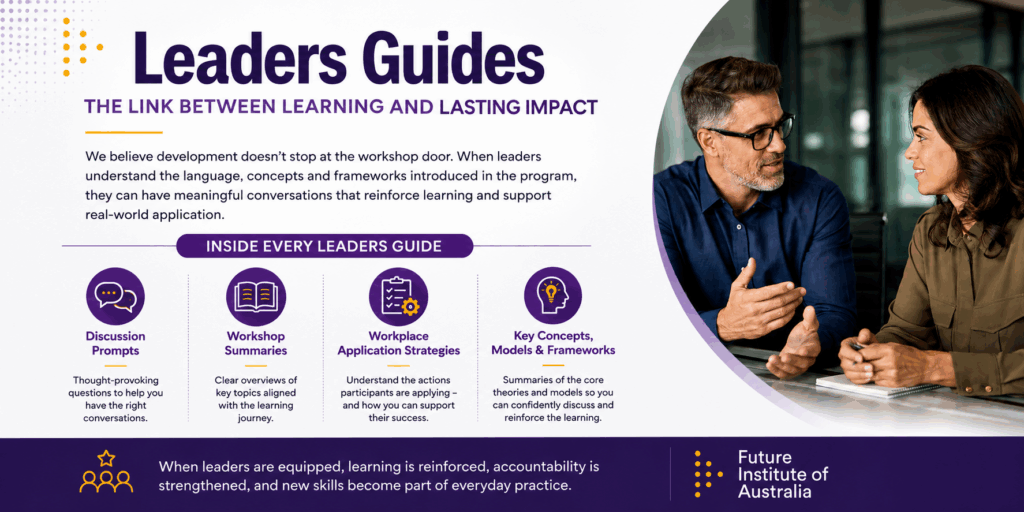
Each Leaders Guide is tailored to the customised development program and provides the participants line managers with the tools and confidence to support participants effectively throughout the learning journey.
The guide includes:
Recommended Discussion Prompts
After each workshop session, the participants’ managers receive structured discussion prompts designed to facilitate meaningful conversations with participants.
These prompts encourage reflection, reinforce key learnings, and help participants identify practical ways to apply new concepts in their role.
Rather than simply asking, “How was the workshop?”, managers are equipped to have deeper coaching conversations that create accountability and support behavioural change.
Workshop Topic Summaries
Each guide contains a concise overview of the key topics covered during the workshop sessions.
This allows the participants’ managers to understand the context of the learning experience and stay aligned with the development journey their team member is undertaking.
It also enables leaders to reinforce the language, concepts, and behaviours introduced during the program.
Workplace Application Strategies
Learning is most effective when it is applied immediately and consistently.
The Leaders Guide outlines the Workplace Application Strategies participants are expected to implement between workshops. These activities encourage learners to practise new skills in real workplace situations, helping to build confidence, capability, and habit formation over time.
The participants’ managers play an important role in supporting these activities by providing feedback, guidance, and opportunities for application.
Core Concepts, Models, and Frameworks
To strengthen understanding and consistency, the guide also includes summaries of the key theories, concepts, and models introduced during each session.
This ensures line managers can confidently discuss and reinforce the learning, even if they did not personally attend the workshops themselves.
By creating a shared understanding between participants and leaders, organisations build stronger alignment and greater learning impact across teams.